

How Loose Is Too Loose? When Non-Surgical Skin Tightening Can Still Make a Difference
You notice it first in a photo. Your jawline looks a little softer. The skin beneath your chin doesn’t seem quite as firm. Maybe your eyelids are beginning to look slightly heavier, or the skin around your knees or abdomen doesn’t bounce back the way it once did.
But you’re nowhere near ready for surgery.
This is the stage of aging that can be surprisingly difficult to navigate. You may want something more meaningful than another facial or skincare product, but you don’t necessarily want, or need, a facelift or other surgical procedure.
So where does non-surgical skin tightening actually fit?
For the right degree of skin laxity, treatments such as Thermage® FLX can occupy that space between skincare and surgery: stimulating collagen beneath the surface to gradually create firmer, smoother and more defined-looking skin without incisions or injections. And timing may matter more than most people realize.
The Skin-Tightening Question Isn’t Really About Your Age
There’s no magic birthday when someone suddenly becomes a candidate for skin tightening. Two people who are both 45 can have very different skin. Genetics, cumulative sun exposure, weight fluctuations, collagen quality and the natural aging process all influence how quickly firmness changes. That’s especially relevant here in Southern Arizona, where protecting skin from years of intense UV exposure is an important part of any long-term skin strategy.
Instead of asking:
“Am I too young, or too old, for Thermage?”
A better question is:
“How much skin laxity do I actually have?”
That distinction changes the conversation. With 20 years of experience using Thermage, Dr. Sofia Rubbani understands that the right treatment starts with an accurate assessment of your skin, not simply your age. A consultation with Dr. Rubbani and the experienced Tucson Cosmetics team can help determine the degree of skin laxity, whether Thermage FLX is likely to deliver the improvement you’re looking for, and which approach is best suited to your individual needs.
The “Pinch, Pull or Lift” Way to Think About Loose Skin
Skin aging exists on a spectrum rather than in neat categories, but here’s a simple way to understand it.
PINCH: Early Loss of Firmness
Your skin still looks relatively firm, but you’re beginning to notice subtle changes: less elasticity, early crepiness, a slightly softer jawline or the beginning of laxity around the eyes. This can be an excellent time to think about collagen, not because you need a dramatic transformation, but because you want to support the structure you still have. The concept is increasingly referred to as prejuvenation or “collagen banking”: intervening earlier to encourage collagen remodeling rather than waiting for advanced laxity.
PULL: Visible Laxity, But You Don’t Want Surgery
Now you can clearly see the change. Perhaps the jawline isn’t as crisp as it used to be. There’s mild looseness beneath the chin, your cheeks look less firm, or skin on the abdomen, arms or knees has become noticeably more lax. This is where Thermage FLX skin tightening can be particularly interesting for appropriately selected patients.
It doesn’t remove skin. Instead, monopolar radiofrequency energy heats collagen-rich layers beneath the surface, causing existing collagen fibers to contract and initiating a longer remodeling response. Because that process takes time, the change isn’t designed to look like you suddenly had something “done.” Your skin gradually becomes firmer.
LIFT: When Loose Skin Has Become Significant
This is the part that sometimes gets lost in conversations about non-surgical treatments:
A device cannot reproduce surgery. If there is substantial excess skin, pronounced jowling or significant tissue descent, non-invasive radiofrequency may not provide the degree of correction you’re looking for. That’s not a failure of Thermage. It’s simply a different tool for a different problem. The goal of a good cosmetic evaluation isn’t to sell everyone the same treatment. It’s to determine where you fall on the spectrum—and whether a non-surgical option can realistically produce a change you’ll appreciate.
What Actually Happens to Your Collagen After Thermage?
This is where Thermage becomes more interesting than the phrase “skin tightening” suggests. Thermage FLX uses monopolar radiofrequency energy to deliver controlled heat into deeper, collagen-rich tissue while protecting the skin’s surface. The heat affects existing collagen and initiates a biological remodeling response.
Research examining monopolar radiofrequency has demonstrated changes in collagen density and organization following treatment. Rather than ending when you leave the office, this remodeling process continues over the following months. Think of Thermage less like pulling skin tighter and more like asking the skin’s structural support system to remodel itself. That’s why patience is part of the treatment.
Thermage as Prejuvenation
Collagen banking with Thermage is an increasingly popular “prejuvenation” strategy, especially among younger patients who want to start early and age slowly by preserving their skin’s structural capital before visible laxity appears. Since collagen production declines by about 1% annually starting in the mid-to-late 20s, proactive RF treatments can help accumulate a reservoir of new collagen, support skin longevity, and delay the signs of aging. This preventive approach is all about future-proofing your face, so you can maintain a snatched jawline, a natural glow, and firmer, more resilient skin without surgery.
The Thermage Result Isn’t Supposed to Peak Tomorrow
One of the biggest misconceptions about non-surgical skin tightening is expecting the final result immediately. Some initial tightening may be visible after treatment, but Thermage results typically continue developing over approximately two to six months as collagen remodeling progresses.
That’s actually part of the appeal. There’s no sudden overnight change to explain. You simply begin looking a little firmer and more defined over time.
Where Can Thermage FLX Make the Biggest Difference?
Most people associate skin tightening with the lower face, but laxity doesn’t stop at the jawline. Thermage FLX can be used on several areas where collagen loss becomes visible, including:
Jawline and lower face
For early jowling, loss of definition and a softer facial contour.


Around the eyes and eyelids
Thermage has a dedicated treatment tip designed for the delicate eye area and can address mild to moderate laxity around the eyes.


Under the chin and neck
For patients beginning to notice looseness but who aren’t ready for surgical correction.


Abdomen and waistline
Especially when skin has become mildly lax with age or weight changes.
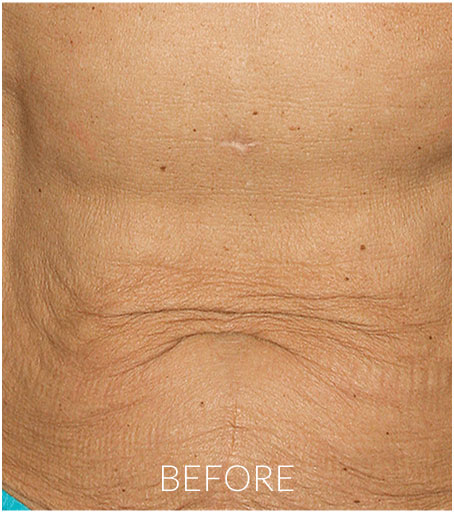

Arms, thighs and above the knees
Areas where thinning and crepey skin can become increasingly noticeable over time.


The important word is mild to moderate. Patient selection makes a significant difference in whether a non-surgical tightening treatment is likely to meet your expectations.
One Treatment, Then Your Skin Does the Work
Another reason Thermage FLX stands apart from many aesthetic technologies is that it typically doesn’t require an initial series of three, four or six appointments. For many patients, one treatment is performed and the collagen response develops over the months that follow.
Thermage reports that measurable results following a single treatment can develop over two to six months and may last approximately one to two years, depending on skin condition and the natural aging process. Some patients choose periodic maintenance treatments as part of a longer-term approach to maintaining skin firmness.
But Does Thermage Hurt?
This is probably one of the questions people Google but don’t always ask during a consultation.
You will feel it.
During treatment, each radiofrequency pulse produces a brief heating sensation followed by cooling. Thermage FLX also incorporates vibration technology designed to improve treatment comfort. The intensity can be adjusted throughout treatment according to the individual patient and treatment area.
There’s an important distinction between non-invasive and feeling nothing. Thermage works by delivering controlled energy into tissue, so some sensation is expected. The advantage is what happens afterward. There are no surgical incisions, stitches or traditional recovery period. Temporary redness or minor swelling can occur, but most patients can return to normal activities immediately.
Thermage vs. RF Microneedling: They’re Not the Same Treatment
This is another source of confusion.
Both Thermage FLX and treatments such as Secret™ RF use radiofrequency, but they deliver that energy differently and aren’t interchangeable. Thermage is completely non-invasive and is primarily a tightening-first treatment, making it particularly useful when firmness and laxity are the main concerns. RF microneedling uses tiny needles to deliver energy into the skin and can be particularly useful when the treatment plan also emphasizes texture and skin remodeling. For our patients, choosing between them isn’t even necessary. Different technologies can be used strategically when someone has multiple concerns.
The question should always be:
What does your skin actually need?
Not:
Which machine is trending right now?
What About Thermage vs. a Facelift?
Think of them as two completely different levels of intervention. A facelift surgically repositions tissue and removes excess skin. Thermage does neither. Thermage stimulates collagen remodeling to improve firmness and mild-to-moderate laxity.
That makes Thermage particularly attractive for someone who looks in the mirror and thinks:
“I’m noticing some sagging, but I’m not ready for surgery.”
For more advanced laxity, surgical options such as a mini facelift or neck lift may provide a degree of correction that a non-invasive treatment simply cannot. Knowing the difference before treatment is one of the most important parts of achieving a satisfying result.
Why Experience With Thermage Matters
Technology is only part of a cosmetic treatment. The more important question is how, and on whom, it is being used. That experience is particularly valuable when deciding whether Thermage is the right treatment at all. Sometimes the best plan is Thermage alone. Sometimes another treatment is more appropriate. And sometimes the degree of laxity has reached the point where a surgical option deserves to be part of the conversation. The objective isn’t simply tighter skin. It’s choosing the right level of treatment for the change you’re actually seeing.
So, Should You Tighten Now or Wait?
If you’ve started noticing that your skin isn’t quite as firm as it used to be, you don’t necessarily need to wait until the change becomes dramatic before doing something about it. In fact, the growing interest in collagen-focused “prejuvenation” is based on almost the opposite idea: supporting and remodeling collagen while much of the skin’s underlying structure is still intact.
Thermage FLX won’t freeze aging, and it isn’t a substitute for surgery when significant correction is needed.
But for the person somewhere between “my skincare isn’t enough anymore” and “I’m not ready for a facelift,” non-surgical skin tightening can fill an important gap. And that may be the best way to think about Thermage: Not as a non-surgical facelift, but as a way to make the most of the skin you still have.
Considering Non-Surgical Skin Tightening in Tucson?
A personalized evaluation with Dr. Sofia Rubbani can determine how much laxity you have, whether Thermage FLX is appropriate for your skin, and whether another treatment, or combination of treatments,would better address your goals. Book your consultation here.